Buyer's guide / Construction
Concrete Cover Blocks: Why 20 mm of Cover Decides How Long Your Slab Lasts
What concrete cover is, typical cover for slabs, beams, columns and footings, and how many cover blocks you need. A site guide from the Siyaganj counter.
Published 4 min readHM Ibrahim & Co, Siyaganj, Indore, since 1939
Open a thirty year old slab that has started to crack and you will often find the same thing. The steel inside has rusted, swelled and pushed the concrete off. The bars were never in the right place.
The cause is almost always cover. Not enough concrete between the steel and the outside.
What cover means
Cover is the distance from the surface of the concrete to the nearest surface of the steel, usually the stirrup. It protects the bar from air, water and fire.
Too little cover and moisture reaches the steel, which rusts and expands. Too much cover and the bar moves away from where the design needs it, and the member is weaker.
Typical nominal cover
These values are the usual starting points under IS 456 for mild exposure. Your drawing sets the exact number.
| Member | Typical cover |
|---|---|
| Slab | 20 mm |
| Beam | 25 mm |
| Column | 40 mm |
| Footing and foundation (earth side) | 50 mm |
| Members in moderate exposure | 30 mm and up |
| Members in severe exposure (coastal, drainage) | 45 mm and up |
Always follow your structural drawing and specification. These numbers are for orientation only: cover also depends on exposure, fire rating and bar diameter, and your engineer should confirm any table you use.
What a cover block does
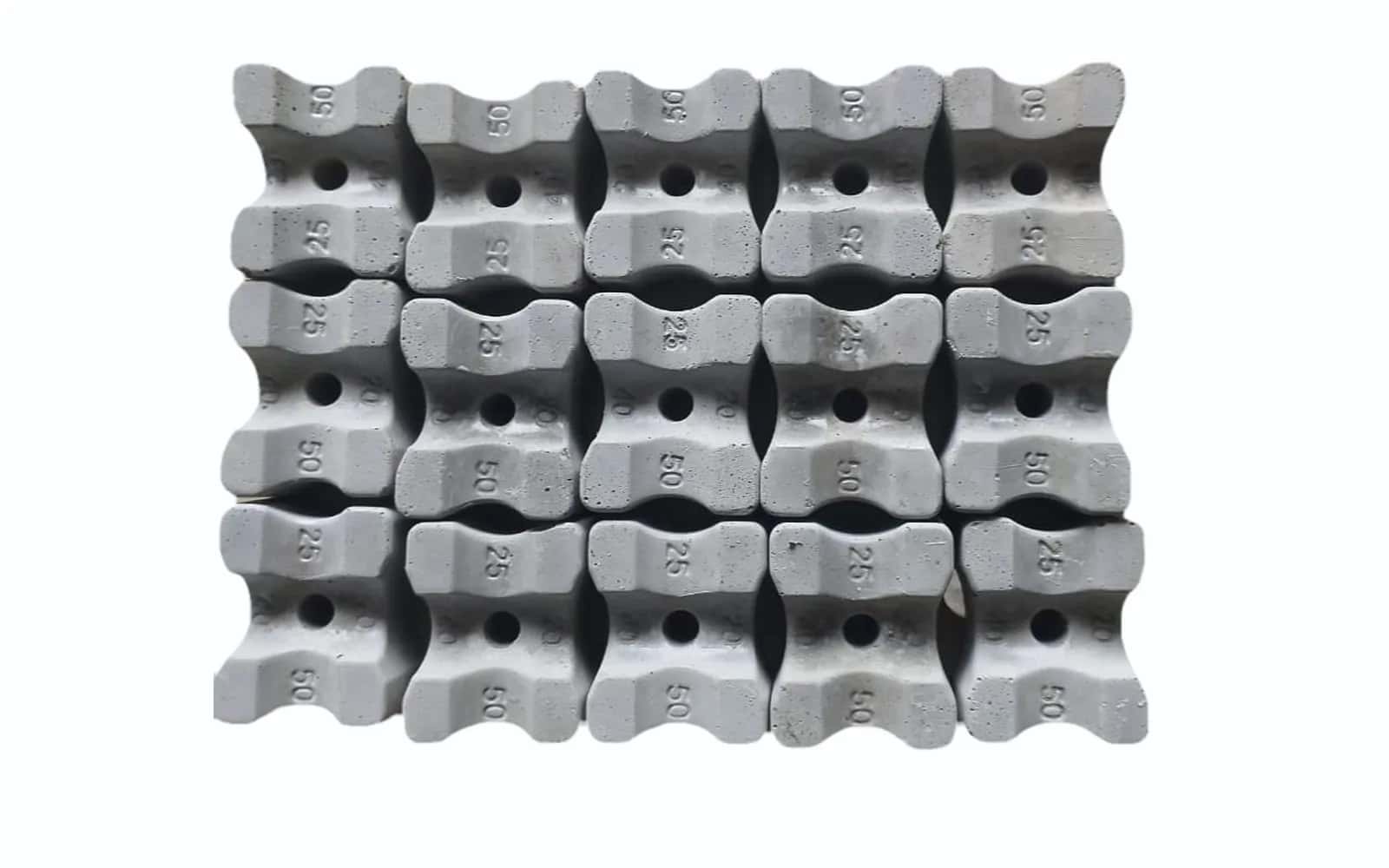
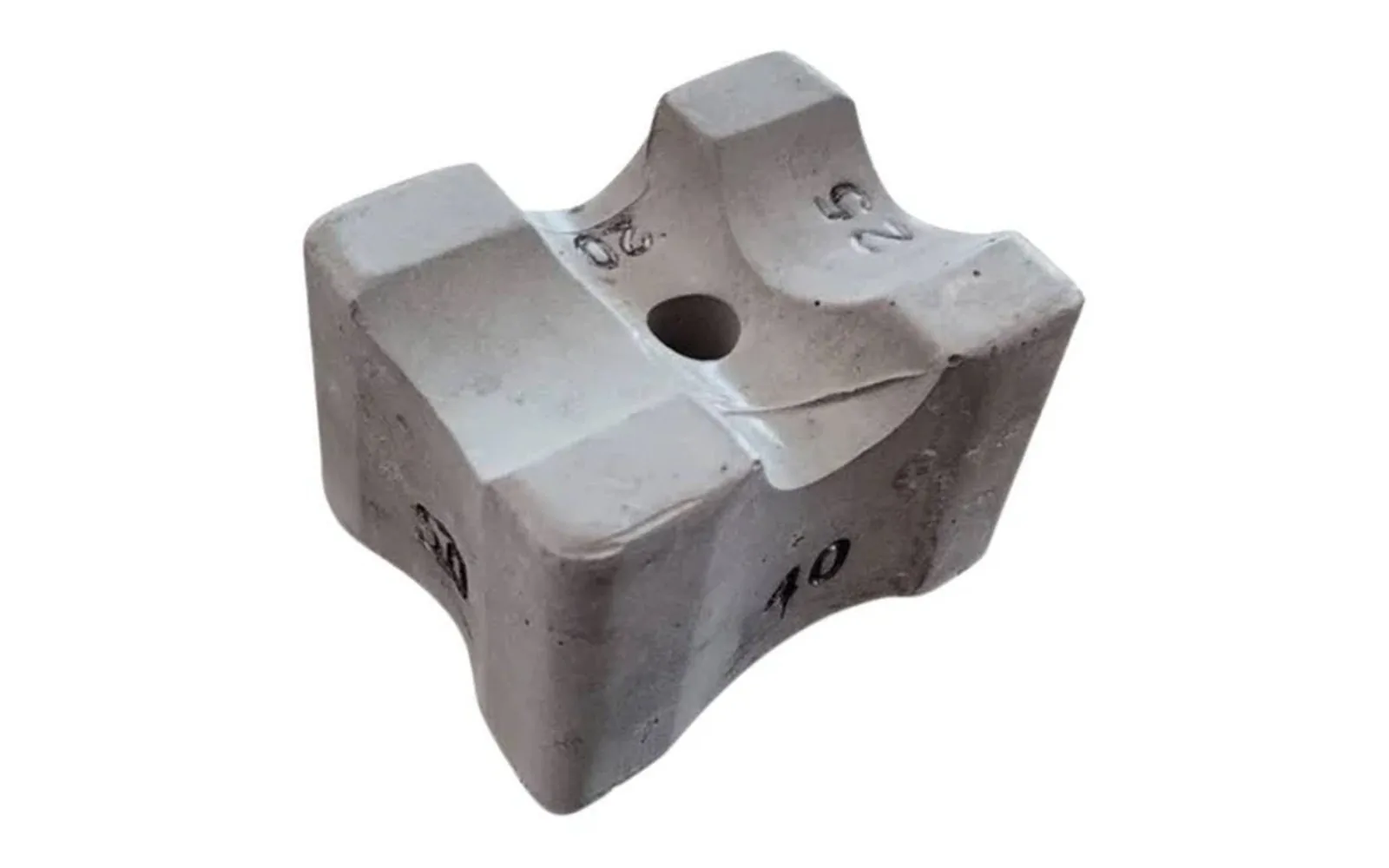
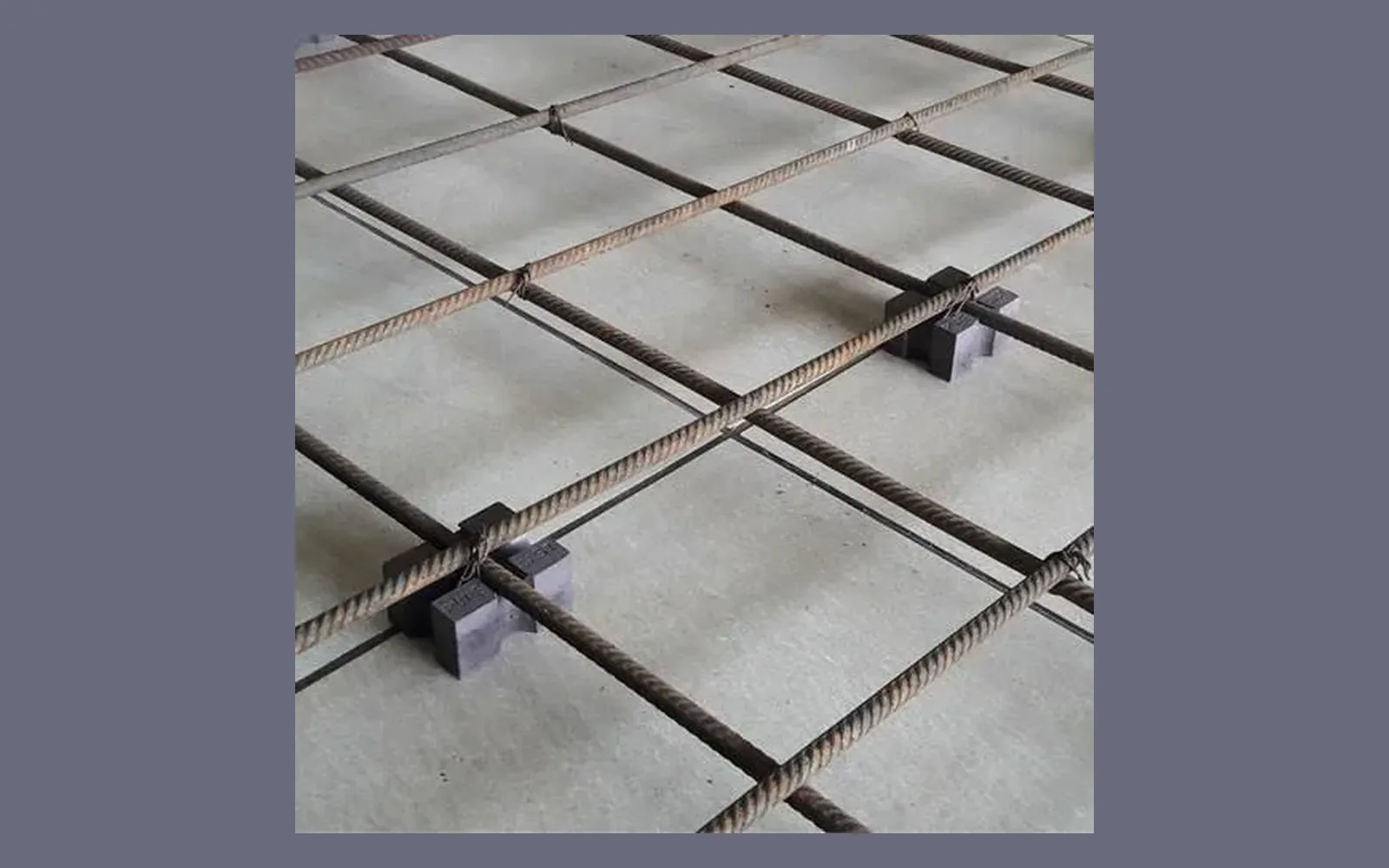
A cover block is a small precast concrete block, with tie wire cast in or a hole through it. It sits between the shuttering and the steel to keep a fixed gap during the pour.
Without blocks, bars sag onto the shuttering. After the pour, the bar is at the surface, with no cover at all.
Why improvised spacers are a problem
Broken brick, stone chips and wooden pieces are not specified spacers. They go wrong in three ways:
- They can absorb water and become a path for it to the steel.
- They are uneven, so cover varies from bar to bar.
- They may bond poorly to the pour, leaving a weak patch.
Use spacers that the engineer's specification approves, such as precast cover blocks of the specified grade or approved plastic spacers.
How many blocks do you need
A rough rule for a slab is about one block every 0.5 to 1 metre in each direction, with bars supported so they do not sag between blocks. For a typical 1,000 sq ft slab that means several hundred blocks. Treat this as a budgeting figure only.
The spacing comes from the site engineer's specification. For beams, use blocks on the sides and the bottom at every 1 metre or so. For columns, place blocks on every face at each stirrup level.
Sizes
Cover blocks are made in the common cover sizes: 20, 25, 30, 40 and 50 mm. The block size must match the cover on your drawing. A 25 mm block under a 20 mm slab bars is a mistake.
Checklist before the pour
- Cover size matches the drawing.
- Blocks tied to the bars with binding wire so they do not shift.
- Spacing even, with no sagging bars between blocks.
- Chairs (bar supports) under top steel in slabs.
- Check the blocks by eye and with a tape after fixing. Keep planks as walkways so people do not stand on the steel and push bars down onto the blocks.
Buying cover blocks in Indore
We stock concrete cover blocks in the usual cover sizes, sold by the piece or by the hundred. Send the cover sizes and the quantity and we call back with a rate. It is a small line on the bill that protects a large structure.
FAQs
What is the cover for a slab?
Typically 20 mm for mild exposure. Check your drawing.
What is the cover for a column?
Typically 40 mm, or the bar diameter, whichever is larger.
Can I use broken bricks as cover?
Not unless your specification approves it. Use the specified cover blocks or approved spacers; brick absorbs water and gives uneven cover.
How are cover blocks fixed?
Tied to the rebar with binding wire, or pushed in with built-in wire.
Are plastic cover blocks good?
They are used too and are easy to fix. Concrete blocks bond better with the pour.
From the shelf
 Binding WireAnnealed binding wire for RCC work.Ask for rate
 Concrete Cover BlocksConcrete cover blocks (spacers) for RCC rebar cover.Ask for rate
 GI WireGalvanised iron wire for binding, fencing, and general use. Tata Wiron available.Ask for rate
 Jhatka WireJhatka machine wire for fencing and agricultural use; quality wire for boundaries and farm applications.Ask for rate
Keep reading
 TMT Bar Weight Chart: 6–32 mm, and How to Check a DeliveryTMT bar weight per metre and per piece for every common diameter, the formula behind it, and how to check a delivery against the paperwork. From the counter at Siyaganj, Indore.5 min readRead
 How to Choose TMT Bars in Indore: Grades, Brands, UseHow to choose TMT bars in Indore: Fe 500, Fe 550 and Fe 500D grades, common sizes, what to check, and where to buy in Siyaganj.3 min readRead
- TMT Bar Rate in Indore: What Decides the Price of SariyaWhat moves the rate of TMT bars (sariya): diameter, grade, length, brand and quantity, and what to send so a dealer can quote you properly. From the counter at Siyaganj, Indore.3 min readRead
Ask the counter
Send the product, size and quantity. We confirm stock and call back with the rate.